Lab Out Loud®

Science for the classroom and beyond

Entries Tagged ‘chemistry’

Episode 37 – Science Because We Can

Audio clip: Adobe Flash Player (version 9 or above) is required to play this audio clip. Download the latest version here. You also need to have JavaScript enabled in your browser.

Dr. Theo Gray

Dr. Theo Gray

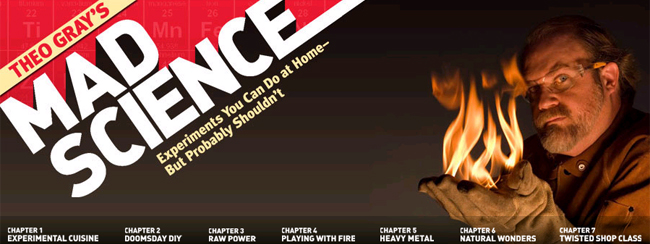
Our guest this week has some serious accolades that would make any geek proud: he has won an Ig Nobel prize (2002), been referenced in a Foxtrot comic, and owns the domain name periodictable.com.  Dr. Theo Gray talks to us this week about his tables, science experiments and safety, Wolfram Alpha, and even answers some student questions.

Links:


Books:


Making Salt the Hard Way


Bacon: The Other White Heat


Direct download: LOL37.mp3

Leave a Comment

Episode 23 – The Periodic Table of Videos

Audio clip: Adobe Flash Player (version 9 or above) is required to play this audio clip. Download the latest version here. You also need to have JavaScript enabled in your browser.

Dr. Martyn Poliakoff

Dr. Martyn Poliakoff

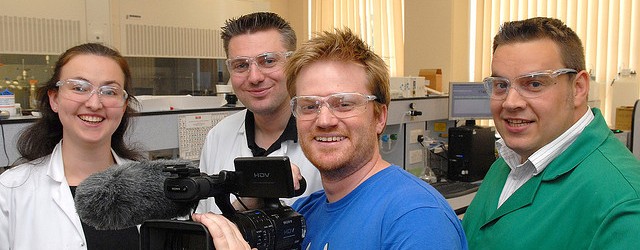
Our second international podcast brings us to the University of Nottingham, where The Periodic Table of Videos is hosted.  An online periodic table that includes short videos about each element, the PTOV has been watched over 3.9 million times.  Dr. Martyn Poliakoff, CBE – a research professor at the University of Nottingham – tells us about The Periodic Table of Videos, a project made possible with his team and video journalist Brady Haran.


PTOV Intro


PTOV Trailer


PTOV Christmas Video


Direct download: LOL23.mp3

Leave a Comment

Episode 22 – When Good Chemicals Go Bad

Audio clip: Adobe Flash Player (version 9 or above) is required to play this audio clip. Download the latest version here. You also need to have JavaScript enabled in your browser.

In this episode, Maryann Suero and Ken Roy warn us of safety dangers lurking in schools – both in the science lab and beyond.  Dr. Suero is the Children’s Health Program Manager for the EPA Region 5 (Midwest Region), and Ken Roy is the Director of Environmental Health and Safety for Glastonbury Public Schools in CT, the Safety Compliance Consultant for NSTA, and a safety columnist for the Science Teacher and for Science Scope.

SC3: Schools Chemical Cleanout Campaign
The Schools Chemical Cleanout Campaign (SC3) aims to ensure that all schools are free from hazards associated with mismanaged chemicals. SC3 gives K-12 schools information and tools to responsibly manage chemicals.

No More Methyl Something

View SlideShare presentation or Upload your own. (tags: laboutoud science)

OSHA Lab Standard and HazCom Standards websites:

Safety Links

For safety Issues in Schools – email NSTA’s Science Safety Compliance Consultant/Safety Columnist/Author: Dr. Ken Roy at Royk@glastonburyus.org

Direct download: LOL22.mp3

Leave a Comment

Subscribe to Flinn Safety Training Notes

Flinn Safety Training Notes

Flinn Safety Training Notes

Each month, Flinn Scientific provides “Science Department Safety Training Notes”.  This month’s notes are “Safety Guidelines for Chemical Demonstrations.”

From Flinn:

Chemical demonstrations can produce attention-grabbing results that dramatically illustrate chemistry in action–from making fountains of foam to creating kaleidoscopic colors, and generating flashes of fire. This month’s safety training reminds you that safety must always come first by providing important guidelines to consider before doing any chemical demonstration.

To receive Flinn’s Safety Training Notes, simply subscribe at www.flinnsci.com/contact_safety.asp.

Flinn also maintains an extensive MSDS database, with 2-page, printable Material Data Safety Sheets.

Leave a Comment

Episode 17 – Sir Harold Kroto on Science Education

Audio clip: Adobe Flash Player (version 9 or above) is required to play this audio clip. Download the latest version here. You also need to have JavaScript enabled in your browser.

Sir Harold Kroto

Sir Harold Kroto

To open our second season, we talked with Sir Harold Kroto. Kroto won the Nobel Prize in Chemistry in 1996 (along with Curl and Smalley) for the discovery of fullerenes. He talks to us about a loss of hands-on experiences in our world, how to reform science education, and offers a new resource for science (and other) educators.

Links:

This episode is sponsored by Frey Scientific

This episode is sponsored by Frey Scientific

Preview from the Show:

Kroto: I think it’s clear that science education is not in great shape. If we look at the way in which the number of kids going in to science has not increased sufficiently, and we have massive technical problems to solve for survival and sustainability, and so we have to use all the tools at our disposal. And the new one, the internet, which has hardly started, and it seems to me that one way of using it effectively, would be to create a global cache of educational materials that teachers anywhere in the world can actually download.

Kroto: Our world is now full of technology which is almost impossible to get your hands on, or if you want to understand it, it’s very difficult for young kids to understand it…. I think people haven’t fully appreciated that my generation, and generations before, learned how the world worked by breaking it up and taking it to pieces and trying to put it back together again.

Dale: What advice do you have for [science teachers] to reform, or jumpstart science education?

Kroto: Well, it’s a massive problem, because it’s not just the teachers, it’s what the kids do themselves. I don’t know how to solve it really, because the world in which I was immersed was the world in which I was immersed, and it was a hands-on one. When the telephone didn’t work, I went inside it – and the bell wasn’t running or something…. But now if the television set doesn’t work – it’s obsolete. That presents a massive problem for the science teacher, and engineering and technology teachers. It needs really development of hands-on skills. And the problem is that modern kids are so subjected to immediate gratification, they don’t have the patience to go through rigmarole that I did.

Kroto: We’re now in a highly technical world, with many people in influential positions – in politics, in law, in journalism – who know nothing whatsoever about science. And yet, they’re making decisions on science, they’re talking about science, they don’t understand science. All they know about science is what is the use of it? They are not interested in the culture itself. They don’t go to a poet and ask “what’s the use of your poetry?” They don’t go to a writer and ask “what’s the use of it?” They can see, because they’re used to that culture, and see the essence of Shakespeare, or whatever the language. In our case, on average, people who are non-scientists just look at the scientific progression as a bunch of people who produce some useful technology. But they don’t think of us as a culture, which is what we are. And in fact, I would say, one of the most important cultures, because we are based on a very important philosophy, which is doubt, and to question everything, and to not accept dogma unjustified by experiment.

Brian: You are actually starting a new tool that is going to try to help teachers get a little bit firmer foundation on what they’re doing, and give them some resources. Could you tell us a little bit about that before you go?

Kroto: The new technology out there allows us to see a person teaching, together with the teaching material. And so what we are doing, in Florida State, is setting up what we call GEOSET – Global Education Outreach for Science, Engineering and Technology. And math as well, and other things… so it’s not just restricted to the sciences. There are two screens, one with the video, so it’s like YouTube, and the second screen is almost like Wikipedia, but it’s downloadable. In fact, PowerPoint is what most presenters use.

Direct download: LOL17.mp3

Comments (1)

Episode 11 – Death of the Chemistry Set

Audio clip: Adobe Flash Player (version 9 or above) is required to play this audio clip. Download the latest version here. You also need to have JavaScript enabled in your browser.

Chemset

This week we talk with Steve Silberman, contributing editor for Wired Magazine. Steve talks to us about the demise of the chemistry set (as related to his article Don’t Try this at Home) and what that might mean for the future of scientific curiosity in our children.

Preview from the Show:
In the last few years, a kind of perfect storm of concerns and legislation has arisen that has had the unintended effect of discouraging amateur chemistry.

Kids really want to fall in love with science. And I know how much the teachers really want to communicate their own enthusiasm about science to their kids. But with fears of liability, and these restrictive laws, and just a kind of general paranoia, instead what’s being transmitted to kids is some kind of combination of boredom and fear.

I would say that one of the reasons that I became a science writer was that I had a well stocked chemistry set when I was in elementary school, that contained many things that I am sure are now illegal.

If we’re cutting off the possibility of future generations of being interested in science – at the same time that the performance of American kids in science starts to go down around 12th grade, the number of science and technology related jobs in the world are going continually up – so we’re creating a gap here where we need people in science and technology, but we’re no longer giving them the access to the things that could help them become interested in the subject.

Links:


Direct download: nstalol11.mp3

Leave a Comment


See What's Popular at Lab Out Loud

Find it at Amazon
Become a Fan of Lab Out Loud on Facebook